academia
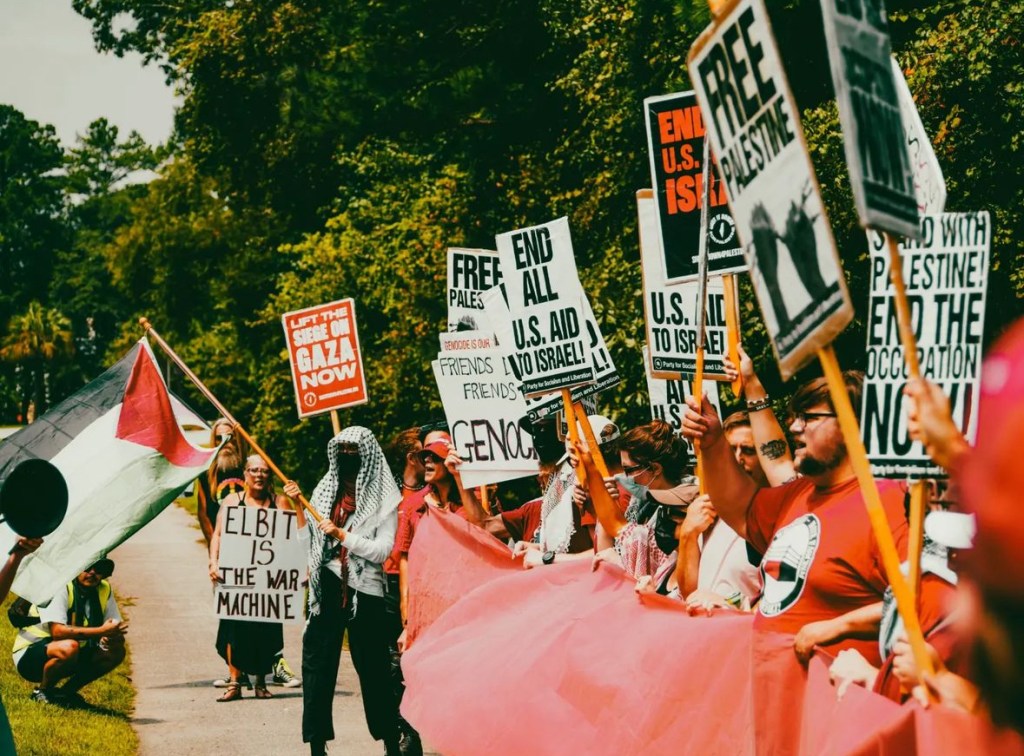
NO VOTES FOR GENOCIDE
photography by Kirb Shots (he/him)
As College of Charleston undergraduates, we joined protests across the Carolinas demanding an end to the genocide in Palestine. Rooted in intersectional solidarity with movements like Queers for Palestine, which opposes the pinkwashing of occupation by Israeli and Western media, we call for liberation and reject the weaponization of queer and trans rights to obscure ongoing oppression. Also guided by anti-imperialist activism, such as About Face: Veterans Against The War and Veterans for Ceasefire, we recognize compounding harms of militarism and the moral imperative to confront state-sponsored violence. Our local protests denounce Elbit Systems—a weapons manufacturer located in Ladson, S.C., that is supplying technology used against Palestinians—and commit to shutting down its operations. We mobilize with national coalitions at the State House in Columbia, S.C., to expose bipartisan complicity in enabling these horrific crimes against humanity.
Women’s and Gender Studies, B.A.
Women’s and Gender Studies explores the intersections of race, ethnicity, class, gender, sexuality, age, religion, and ability. WGS majors study complex structural issues, different contexts, controversies, cultures, and time periods in order to develop critical analyses to process lived experiences and further social advocacy.
WGST 321
Queer and Trans Studies
Cristina Dominguez, Ph.D. (they/them),
Assistant Professor, WGS
This interdisciplinary course offers a selective introduction to queer and trans studies within LGBTQ+ studies. Students explore trans and queer history; theoretical and conceptual writing; auto-ethnography and ethnography; autobiography, memoir, creative writing, film/tv and art; political writing and documentaries. Drawing on the #TransJusticeSyllabus and other sources, some focal areas of this course are QTBIPOC and white anti-racist accomplice theorizing and feminisms, bodies and health, family and community building, nationalism and migration, criminalization and abolition, and, social justice organizing and movement work.
WGST 323
Intersections of Spirituality, Anti-Racism, Social Justice, and Practice
Prof. Drisana ‘Dru’ McDaniel (she/her), Adjunct Professor, WGS
The objectives for this course are to sense with and think together about how we can most effectively navigate and contribute to the present moment. As Sherri Mitchell reminds us, this involves reconciling the external world that we have created with the inner wisdom and understanding that we have gained. Some of this wisdom can be accessed through our lived experiences, but we also pick up what we need to know as a collective about living in the historical, present-day living, and futurist archives of women of color and sometimes others. Together, we will mine these archives, bear witness to the wisdom therein, and tend to the tensions of these times with generative reflection.
WGST 350
Gender, Violence, and Prevention
Malia Lee Womack, Ph.D. (she/her), Adjunct Professor, WGS
This course is an in-depth study of gendered violence. Topics include intimate partner violence, sexual assault, sexual harassment, and violence on a global scale. Students focus on violence at an institutional, symbolic, and individual level. Contrary to neoliberal normative approaches, this course uses feminist theory to explore how gendered violence is largely a product of systematic power inequalities, cultural trends, inadequate legal policies at the local and international levels, and the product of a lack of desire to proactively prevent such violence from occurring.
Sociology, B.S.
Sociology is the scientific study of social life, social change, and the social causes and consequences of human behavior.
Sociologists investigate the structures and factors that organize activities, as well as those that disorganize, deviate, or threaten to dissolve them – ranging from cultural family dynamic to global conflict.
AAST 200
Intro to African American Studies
Anthony D. Greene, Ph.D. (he/him),
Director, African American Studies
The history of African peoples in the United States has largely been a chronicle of strivings for liberation, inclusion, economic justice, and political participation. Much of this story represents Black people’s desires to retain their racial identity and autonomy, to build community and create a sense of nationalism. Thus, this course examines the historical and contemporary lived experiences of Black people in the Americas. We spend a considerable amount of time exploring the origins and prevalence of the discipline (Black Studies); covering a range of Black historical figures, events, debates; examining critical scholars and writers; deconstructing the tenets of racism; and exploring the beauty and diversity of contemporary Black experiences.
SOCY 260
Big Thinkers and Theorists in Sociology
Chris Boan-Lenzo, Ph.D. (he/him), Adjunct Professor, Sociology
This course examines the history of sociological theory. Society is really hard to grasp. It’s like gravity—you can see its effect, but you can’t really see it. And, like gravity, most people know the word society, and understand that it’s a thing that influences our lives, but have no idea what it’s made of or how it actually works. Starting a couple hundred years ago, sociologists started looking at the social patterns around them. They thought creatively, just like Einstein did, about what attributes society must have to produce the patterns they found around them. But, since society is way more complicated than curves in space, the story of sociology is the story of one person saying, “Society has this attribute,” and someone else saying, “Yeah, but it’s also got this!” This class will tell the story of these discoveries.
SOCY 341
Criminology
Heath Hoffmann, Ph.D. (he/him), Professor, Sociology
This course introduces sociological and social psychological studies of crime, focusing on contemporary issues relating to crime and justice in the United States. Students will learn to critically evaluate how crime is portrayed and discussed in the media and by politicians, discern the quality of sources from which information is obtained, examine how crime and justice is used in politics, and demonstrate the ability to think sociologically about the causes of crime to identify and talk about causal factors beyond the psyche or biology of individual offenders.
Mass Communications, A.S.
Mass communication is the process of imparting and exchanging information through multimedia to large population segments. It uses various forms of technology for information dissemination and engagement. The field analyzes how content and information persuades and affects attitude, behavior, and emotion.
WRT 105
Practices of Academic Writing
Nancy Tranter Wright, Ph.D. (she/her),
Professor, Reading and Language Arts
Introduction to literacy as well as its relationship to cultures and communities, identities and ideologies, technologies and media. In this course, writing is both a subject of inquiry and the primary activity. Students engage critically with the opinions and voices of others to develop a greater understanding of the self and the effect writing can have on the audience. Through analysis and argument, these practices carry across academic disciplines and into various professional settings of civic writing.
BPS 321
Rhetorical Awareness and the Diverse Workplace
Prof. Emily Luther (she/her),
Instructor, Writing and English
In this course, students will explore historical trends related to race, globalization, culture, religion, gender, and sexuality and learn how these affect workplace communication today. Students will study challenges in verbal, written, and digital communications within diverse work environments, and learn how to develop positive, team-oriented communication practices. Work will be hands-on and experimental; students will engage realistic conflicts in communication together in a supportive learning environment.
BPS 382
Leading Cooperative Negotiations
Katherine Sosa, Ph.D. (she/her),
Adjunct Professor, Conflict Resolution
In this course you will explore your own ideas about negotiation, assess your predisposition, and have an opportunity to practice implementing the skills and concepts you learn in the weekly live sessions. You will learn to prepare for a negotiation by assessing and mapping out the information you have and preparing for the possibilities. By examining case studies, you will learn how the concepts and strategies apply in different types negotiations.
FeMo Conference 2025 presentation by brin nesryn (they/them), College of Charleston, South Carolina. 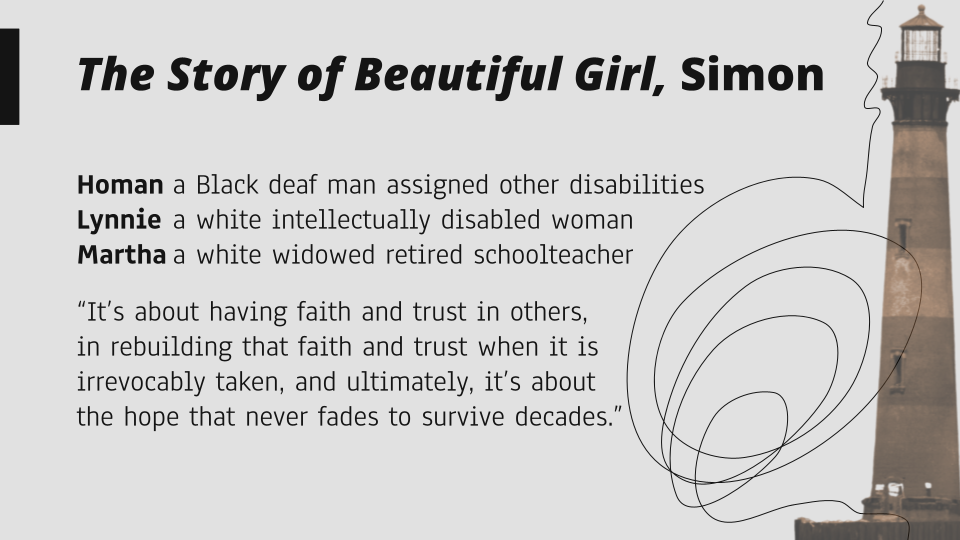
The Story of Beautiful Girl is historical fiction that portrays the compounding impacts on disabled people during forced U.S. institutionalizations of the 1970s. 
The first sociopolitical complication is the idea of desirability – or as Lenard Davis calls it – the construction of normalcy. 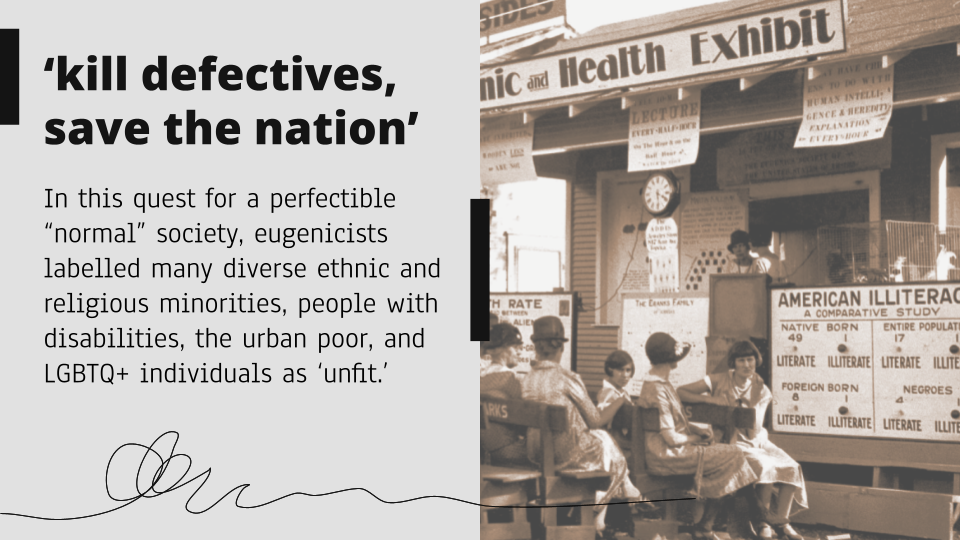
This was done through eugenics, an immoral and pseudoscientific theory, that falsely claims it is possible to ‘perfect’ people and groups through genetics and the scientific laws of inheritance. 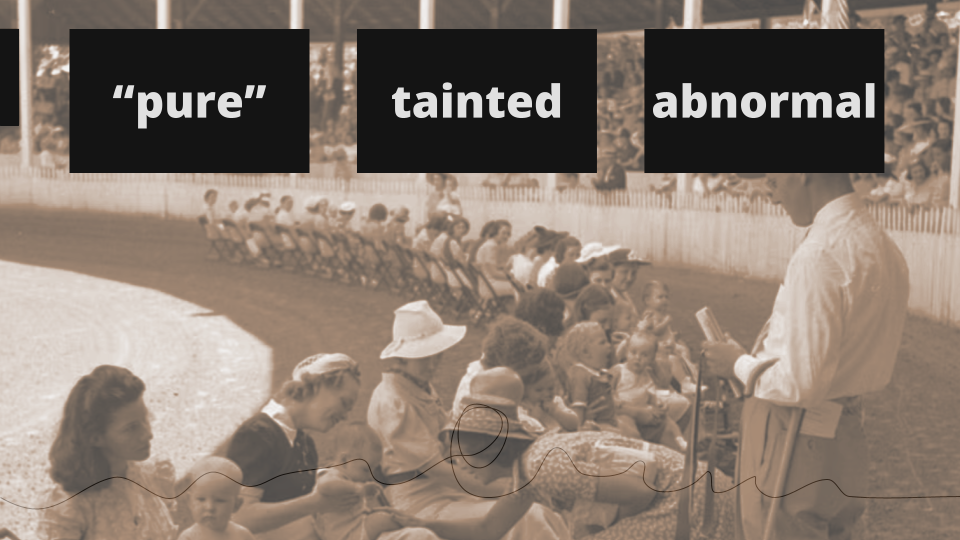
Pictured here is a ‘fitter families contest’ from the 1929 Kansas State Free Fair. National ideals of physical, mental, and moral “fitness” were promoted through white nuclear family competitions across America. 
Carewashing – as conceptualized by Tracy Rosenthal – describes a social distortion of pro-carceral logic that often restrains disabled narratives from disrupting the status quo of established ideology and industry. 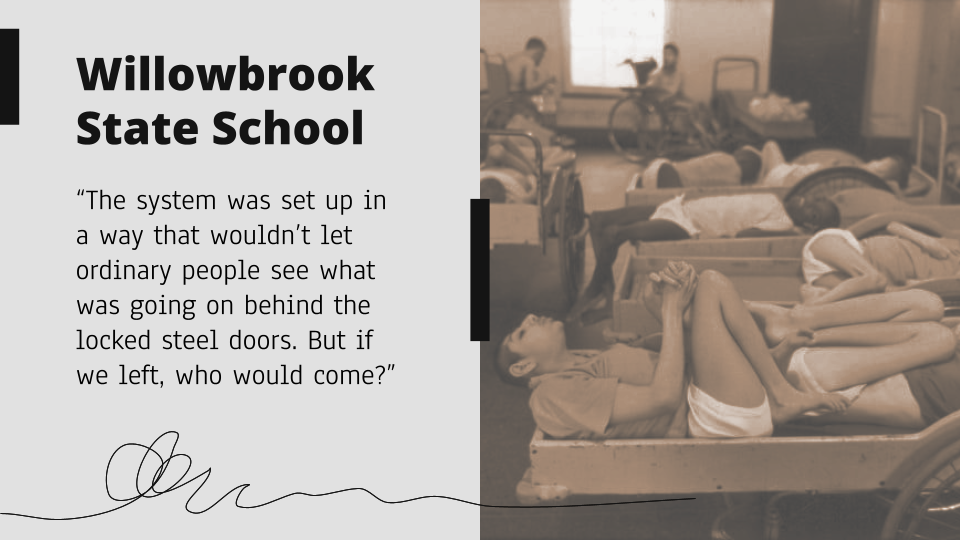
Deinstitutionalization rejects the notion that disabled people are a monolith, that there is a singular way to “care” for disabled communities, or that institutions should disappear any population. 
I argue that all bodies are politicized for the embodiment of ableism, for exploitation under capitalism, and for the afflictions of state violence. 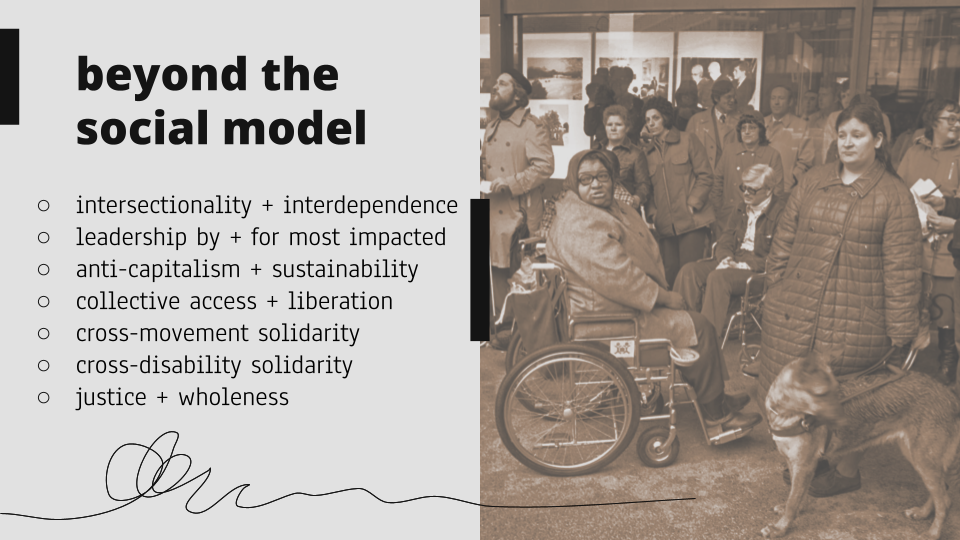
Disability Justice was created by Black and Brown and poor white and queer and trans revolutionary disabled people in 2005 who wanted a movement shaped by non-white disabled people in leadership due to enduring racism and white supremacy in disability rights activism. 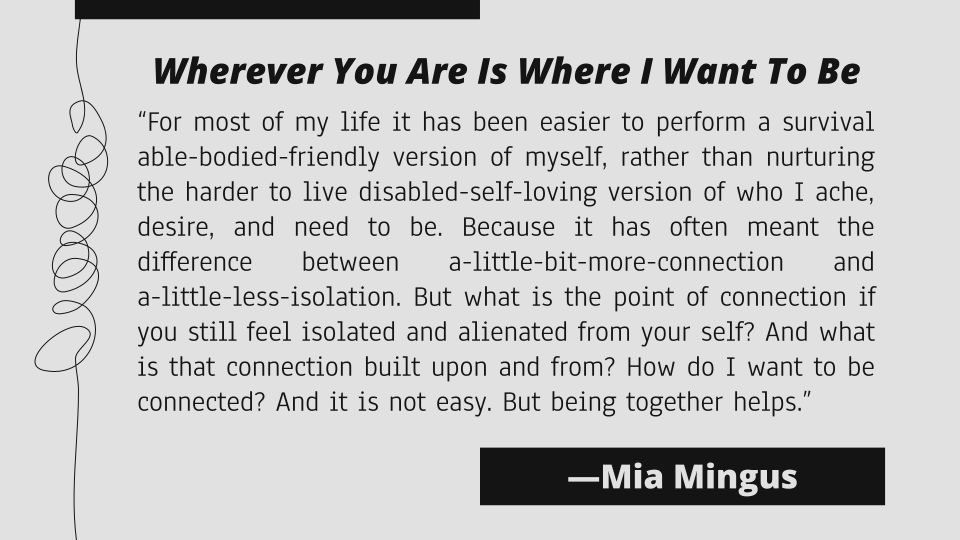
Mia Mingus on crip solidarity, 2010.
queering trans belonging
 brin nesryn